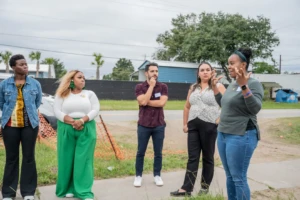
Community Impact Fund Retreat 2022 Photo: National Women’s Law Center / nwlc.org
In 2023, the National Women’s Law Center (NWLC) launched the Community Impact Fund (CIF) to rethink how national advocacy organisations support grassroots change. Rather than deciding funding priorities from the top down, NWLC devolved decision-making power to community leaders in New Mexico and South Carolina whose daily lives are shaped by the issues the fund was designed to address: child care and economic justice.
NWLC established a Design and Advisory Committee (DAC) comprising local organisers, women with lived experience, and state-based advocacy partners including OLE’, the Semilla Project, Metanoia, and the YWCA of Greater Charleston. Over twelve months from June 2023, the DAC did not simply advise staff. They led: defining the problem the fund would address, identifying the target population, developing theories of change, determining what types of solutions to fund, and ultimately selecting the grantees.
NWLC invested in conditions that made genuine participation possible: translation support, stipends for committee members, and flexible meeting formats designed around participants’ lives rather than institutional timetables. The process was described by NWLC as not fast or easy, but deeply inclusive.
The resulting grants, awarded in July 2024 to Partnership for Community Action in New Mexico and BEE Collective in South Carolina, focused on improving economic conditions for early childhood educators, particularly those facing racial and gender discrimination. These two organisations were identified and selected by the people closest to the problem, not by national staff reviewing applications from a distance.
What practitioners can take from this
The NWLC Community Impact Fund is a practical demonstration that participatory design is not simply a consultation exercise. When communities lead from the start, including defining the problem itself, funding becomes more targeted, more relevant, and more likely to address root causes rather than symptoms.